we've been talking about fine print...


BEST MUSIC WRITING & WEST COAST DJING

It’s like this: tonight, Thursday, I will read at the Best Music Writing 2011 event @ Housingworks in Manhattan. Free. Hosted by the New Yorker’s Alex Ross and Daphne Carr, who included my Frieze essay on slowness in music for the book’s 2011 edition. Flyer below.

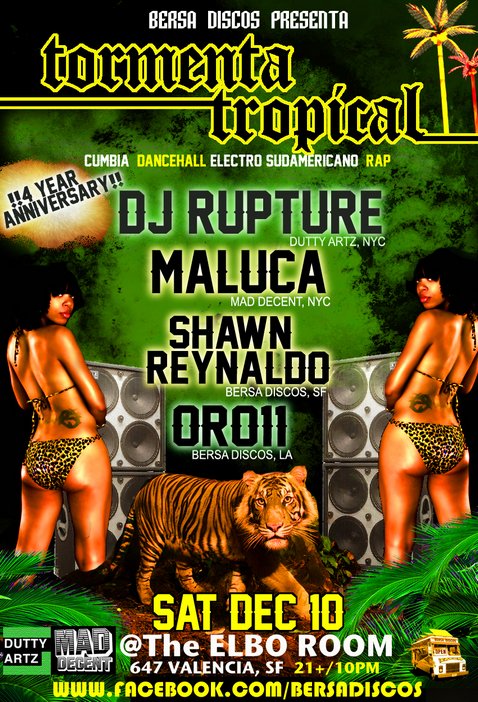
On Friday and Saturday I’ll be shaking things up at a party I’m incredibly excited about: Tormenta Tropical’s 4 year anniversary! Going down in LA and San Francisco. Bersa Discos hosts Oro 11 and Shawn Reynaldo and I will be playing in both cities, along with Maluca. The LA edition brings in Total Freedom and Mas Exitos. Crazy, right?!

Tormenta Tropical is one of those fantastic parties where you, as a DJ, need to step up your game and play extra well. I’ll be digging deep, smuggling in secret weapons & surprises (& cumbia), so see you on the dancefloor.

Then I redeye home in time for Sunday’s Mudd Up Book Clubb: Zoo City edition back in Manhattan. I need to spend serious time in LA but never manage to be there for more than 15 hours at a stretch.

TTLA

TORMENTA 4 YR Updated

BMW events128 correx

December 8, 2011

WIRE MAG COVER TIME

IMG 0068

This is an exciting moment for me — WIRE is a magazine I’ve respected for a very long time.

So, here are the basics: I’m on the cover of WIRE Magazine’s November issue, wearing one necklace of bones and the other of skulls, with my underwear showing. Inside you’ll find a long and thoughtful feature written by Peter Shapiro with photography by Jason Nocito.

They say: “Peter Shapiro meets prolific producer Jace Clayton to hear about post-colonial Bass music, The Shining remade in Dubai and Sufi Plug-Ins.”

October 12, 2011

BOMB: THE BUG

cross-posted to Dutty Artz

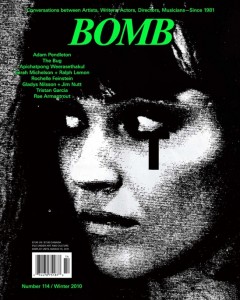
Check the latest issue of BOMB magazine for an in-depth interview with Kevin Martin AKA The Bug. BOMB has just upped an excerpt & audio clip. Here’s an excerpt of the excerpt:

Jace Clayton: You told me this anecdote: you were at a dub night in London; it was lit by one lightbulb. That’s how I remember you describing it—

The Bug: Oh, yeah. That was again a very pivotal moment for me. Just after I moved to London I went to see Iration Steppas and The Disciples do a “sound clash” together. I didn’t know what the hell to expect. It was at a warehouse in the East End. Literally, there was a sound system on either side of a quite small room with a lightbulb hanging above each, no stage, the audience trapped in the middle, and this head-shredding volume and over-the-top psychedelia. Every mix that each producer was playing would get more and more out-there. At first you would think, Oh, this is a nice reggae tune, and by the end you’d be thinking, Holy shit, this is electro-acoustic madness! People were looking stoned, shell-shocked, or both by what was hitting them. (laughter) It almost altered my internal DNA and how I appreciated music. Before I moved to London, I’d seen a very early Swans show and had realized just how much I loved physical impact in sound.


Photo by Niall O’Brien. Courtesy of Ninja Tune.

JC Funny, every time we’ve played together I’ve always tried to leave the building when you were sound checking. It’s massive volume and you take it so seriously; oftentimes if the sound guy is not up to speed, you’ll let him have it. Can you talk about the importance of getting the sound you want in a live situation?

TB Boy, I guess I’ve got a bad reputation for being a bit finicky and demanding. Once you’ve had the experience of what music can be like, if you are a perfectionist and obsessive (like I realize I’ve become), you don’t want to compromise. I don’t follow the idea of making any type of compromise in my life, and definitely not in my music: music is my life. If you’re happy to shut up and let someone water down what you want, then you really shouldn’t be making music. It’s not important enough to you, you know? I believe in a hard-core mentality. Any art should be a pure reflection of the intention of the person making it, and any degree of compromise along the way is just going to lessen the impact of what that person is trying to do. As far as I’m concerned, the physicality of sound is crucial; it takes you beyond intellectual discourse, to very primal, psychological confrontations. I like what it can do to you: it can be seductive, it can be sexy, it can be aggressive, it can fuck you up, it can flatten you, it can wake you up. Intense musical experiences have changed how I live my life, full stop. To some people this may sound a bit over-the-top. My passion is music, and that is reflected in how I approach the live arena. Now, increasingly, when record sales are shrinking, it’s important to leave a statement, to walk away having done something memorable. Volume in itself isn’t memorable; anyone can turn the volume up to 12 and crush someone with it. That’s not impressive. It’s the constructions within the music that are important.

December 27, 2010

FRIEZE: MEXICO CITY REPORT

I bang my fist against the sheet-metal grate. I’m in Mexico City’s historic Centro neighbourhood, a grid of beautiful, busy streets whose structural regularity is pushed into chaos by dense flows of automobiles, people, sounds, smells, all compressed and vivid and hyperkinetic by day, often unnervingly empty at night. Another knock. No answer. I open the dusty metal door.

We spill into the Bósforo, an undecorated clandestine bar specializing in high-proof homebrew spirits. Tonight El Nicho, a ‘virtual space with physical manifestations’ that imports experimental music, has staged its monthly pop-up. . .

Thus begins an essay I wrote for the new issue of Frieze Magazine’s Mexico City report. You can read it here; the page begins with Gabriela Jauregui’s piece, scroll down for mine.

Along with our words, you can listen to “an exclusive playlist for Frieze, curated by Eric Namour of El Nicho Experimental.”

December 21, 2010

NEW MUSE LAST NEWS

Depending on how you hold it, the New City Reader is either a a temporary newspaper that will be published from October 6, 2010 to January 9, 2011 as part of the Last Newspaper exhibition at the New Museum, or a performance-based editorial residency which happens inside the museum.

I’m guest-editing part of the MUSIC/STYLE section. I have assembled a World-Class Crew of Contributors & am super excited to escort their brilliance into print. The NCR editorial team will meet inside the New Museum today around 6pm. You are welcome to come heckle us, suggest things, share tea + cookies + a mate gourd. (entrance is free after 7pm today)

Past editions of New City Reader can be viewed here, and you can grab the current issue at the museum itself. Follow NCR on Twitter, although Twitter hates wikileaks and censors trending topics in yet another weird devolution of transparency (so much for algorithmic populism). So. Where were we? Shopping for electronics on Canal St? Close. We were on Bowery. Inside a museum round the corner from the flophouse.

New City Reader: Public space, urban space, information space, wrapped up with the finger-smudging timeliness of an experimental weekly.

December 9, 2010

DJ SCREW’S SWAMP GOSPEL

DjSREWrecords300dpi_72450w

My latest essay, on the slowed-down tempos of screw + its influence on contemporary bands, has been published in this month’s Frieze and is available online. It begins with DJ Screw and ends with interview observations from Romanian programmer Paul Nasca, responsible for the Bieber stretch algorithm.

Ten years ago this month, one of the great, lazy American geniuses died, at the age of 29, from drinking too much cough syrup. His name was Robert Earl Davis Jr., and I believe he stole the technique that made him famous from the Mexicans. . .

 Frieze_cover_web135_splash

November 8, 2010

ALL SWING RADIO

desolation road

All Swing Radio was vampire music. In some towns to be caught listening to All Swing Radio would earn you a fine, fifty days community service, confiscation of the radio, or even a public flogging. It was the music of subversives, terrorists, anarchists who roamed the empty places of the world on their terrain trikes looking for microwave towers into which they could plug their illegal transmitters and broadcast their subversive, terrible, anarchic music to the kids in the dead-end alleys, the empty gymhalls, the backseats of rickshas, closed-down bars, shut-up co-ops, and little Annie Tenembrae/Mandella listening to the Big Big Sound of the New Music under the quilts at two minutes of two in the morning. It was the best music in the world, it set your feet on fire, friend, it made you want to dance, friend, it made the girls hitch up their skirts or roll up their overalls and dance and the boys somersault and back-flip and spin around the floor, or the concrete, or the packed brown earth: the bold, bad basement music of Dharamjit Singh and Hamilton Bohannon, Buddy Mercx and the King of Swing himself, the Man Who Fell Through the Time Warp: Glenn Miller, and his Orchestra. It was basement music from smoky cellars deep under Belladonna and hole-in-the-wall recording studios with names like American Patrol and Yellow Dog and Zoot Money: it was music that shocked your mother, it was All Swing Radio, and it was illegal.

It was illegal because it was propaganda though it carried no political message. It was subversion through joy.”

– from Desolation Road by Ian McDonald.

Martian magical realism from Belfast. Interconnected short stories arced into a novel. Heavy on the alliteration. A NonWestern.


June 17, 2010

RACHID TAHA

Image

[photo: Rex Features]

My latest article for The National can be viewed online here. I look back at the career of Rachid Taha.

excerpt:

To call him a rock star is to overlook his success in the Arab world as an innovative reinterpreter of rai and chaabi. To label him a pioneering figure in Arab-technopop is to forget the long shadow cast on him by The Clash and other spiky political rockers. And if he’s a rebel, then why all the lush, respectful cover versions from decades past?

Here’s the original version of ‘Ya Menfi’ (The Exiled / The Fugitive), performed by its author, Kabyle musician Akli Yahlatene: “The chains weigh tons. . . / The soup is mere water with cockroaches swimming in the dish.” Yahlatene sings about Algerians in France imprisoned, punished, or killed for their involvement in the Algerian War. Decolonization struggle words; you can think of ‘Ya Menfi’ as a musical counterpart to Franz Fanon’s The Wretched of the Earth, of which Sarte said

…and Taha’s reverent take on ‘The Exiled’, from his 1998 album Diwan:

April 16, 2010

RICHARD SKELTON: LANDINGS

skelton

My article on Richard Skelton - a musician whose work I’ve returned to perhaps more than any other in the past year – has been published in the current issue of Frieze magazine. At newstands now (or soon), and available online. Excerpt:

“His music proceeds as if by geological processes: time feels stretched out, layers accumulate and interlock into complexity, and it’s underpinned by a gravity and drift whose appeal is at once emotional – Skelton’s biography looms large – and elemental, as if these sounds have always hung shimmering in the spaces between air and land.”

February 19, 2010

LIKE REALLY LOUD SILENCE

The current issue of Bidoun magazine features a lengthy interview with Kelefa Sanneh and I on the topic of “noise music”. How we got into as kids in the 90s, what all that racket might have meant. It took me 1.5 subway rides to read it!

(Racial corrective: the intro says that I’m of a mixed race marriage. That’s not the case.)

Here are a few excerpts. If you’ve ever cared about the Gerogerigegege, wondered about Toby Keith’s perversions or what that distortion pedal has to do with American race relations, then this article’s for you. Also, K is really, really funny. 19 SlideShow 01

Kelefa Sanneh: Often with a subgenre that’s like a noisier version of X – often X is a black music, and the noisier version involves white people. Very recently that could be, adding noise to jungle. But we can go back and talk about distortion and amps. We can talk about rock abstracting itself from blues.

Bidoun: Post-punk abstracting itself from funk.

KS: Right. And often the impulse to make something noisier is to make it less black.

Jace Clayton: I agree completely. Party my mixtapes come from… reversing that process? Certainly by the time my interest in breakcore faded, it was this formulaic, “Okay, here’s the sample, here’s the distorted Amen break.” With the sample being so obviously a black male Jamaican voice serving as a sonic signifier of hyper-masculinity, of violence and danger.

KS: But even there, when you’re talking about a distorted Amen break-what does the distortion add to the break, sonically or culturally? Is it a way of insisting that you’re not overly reverent?

JC: Yeah, definitely.

KS: But in the hands of white producers and DJs, what does it even mean for them to be insisting strenuously that they are not overly reverent of the Amen break? Or to have a punk-rock attitude towards it? I mean, I’m fully prepared to admit that this is part of the appeal of noise music; the racial coding of it is kind of interesting. I think for a generation of white music fans, there is an association of noise with a certain kind of authenticity or pugnacity, related to the conception that that authenticity is what’s missing from commercial black pop music. Until Timbaland or whatever. [Laughter]

+ + +

KS: These days, when you say something is “noisy”, that’s another way of saying it’s old-fashioned. In this decade, there’s no reason anything ever has to be lo-fi.

JC: In this decade, noise would be the sine wave wave. If anything, it’s the clean digital sound that is the noisy sound.

KS: Is this the point at which noise converges with its opposite?

JC: Yeah! The sine wave is at once of the cleanest and most piercing of sounds…

KS: Because if a sine wave is noise, what’s the opposite of noise? I guess, silence… if it’s quiet [Laughter]. I mean a lot of those old noise records really sounded like loud silence.

+ + +

KS: . . . Obviously things change, and it’s not impossible to imagine a world where noise signifies its opposite. Which would be totally interesting – a world in which, in America, treble signifies black and bass signifies white. [Laughter] But for now, anyway, white people’s attachment to noise seems pretty primal. I’d almost call it primitive. It seems to touch something in them…

February 2, 2010